ERCOT Data Center Interconnection: Batch Zero, Queue Reality, and What Actually Gets Built
410 GW in the queue. 87% from data centers. Only 1.8% operational. Batch Zero filed March 2026. This is how ERCOT interconnection actually works — and what separates projects that energize from those that wait.
How does ERCOT interconnection work for data centers?
ERCOT processes data center interconnection through a large-load study framework with tiered priority. Batch Zero, filed March 2026, fast-tracks projects demonstrating site control, executed TSAs, and 18-24 month readiness. Complementary frameworks include CLR (curtailable load), BYOG (co-located generation), and Self-Limiting Facility models. Projects outside Batch Zero face multi-year waits in a 410 GW queue.
Key Data Points
- Queue: 410 GW total (up from 63 GW in late 2024), 87% from data centers
- Batch Zero: Filed March 4, 2026 via NPRR/PGRR process
- CLR: Curtailable load under SCED control for early energization
- BYOG: Behind-the-meter co-located generation to offset grid draw
- SLF: Self-Limiting Facility enforces withdrawal caps
- SB6: Cost shift to large-load customers (June 2025)
ERCOT Queue Reality: What the Numbers Say
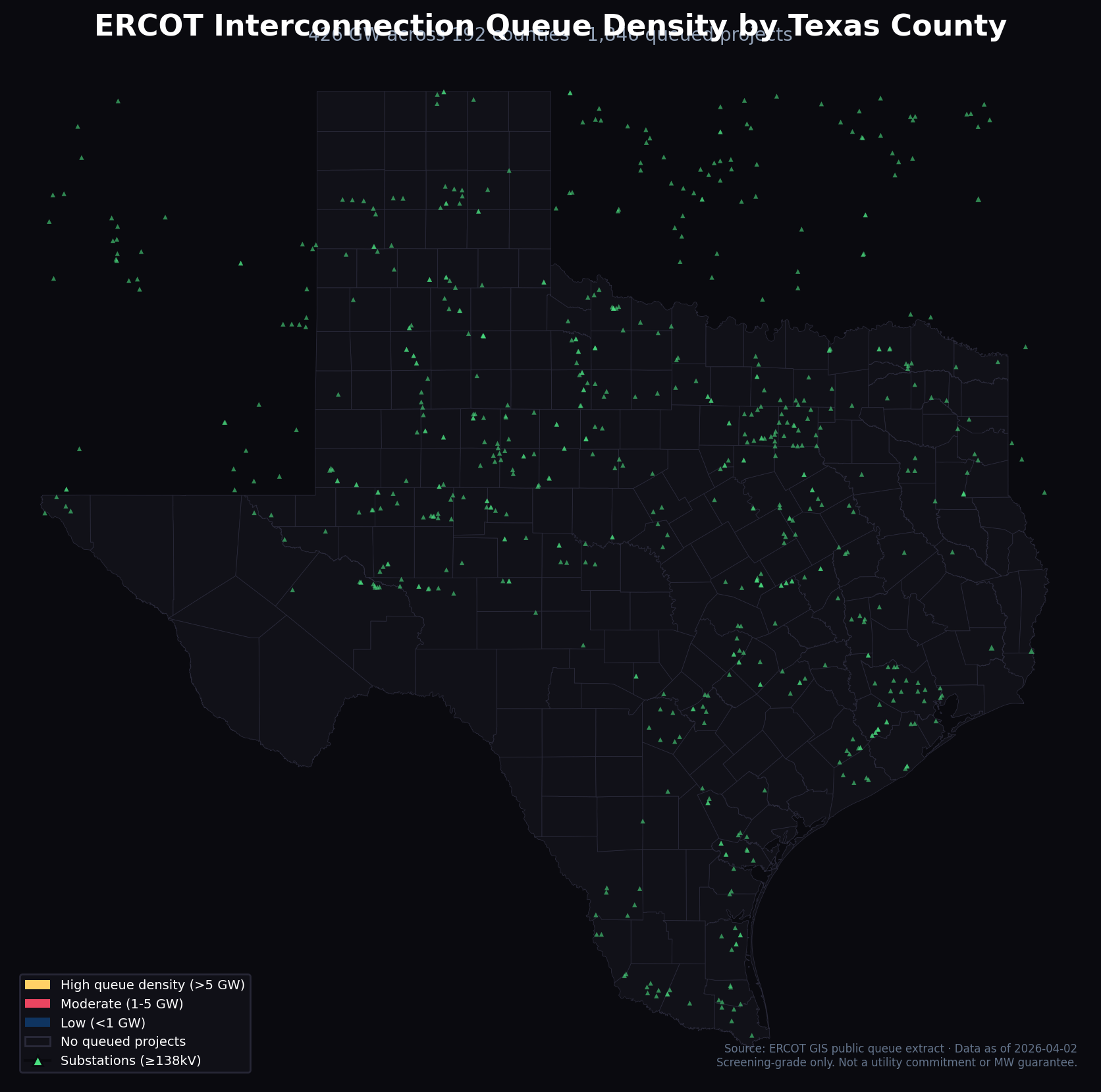
410 GW Total Queue
ERCOT's interconnection queue has surged to 410 GW — up 6.5x from 63 GW just 18 months ago. 87% of requests are from data centers. Only 1.8% of queued capacity is operational. The system was designed for 40-50 projects per year; it received 225+ in 2025 alone.
Source: ERCOT GIS public queue extract · as of 2026-04-02
50%+ Incomplete Submissions
More than half of the 410 GW queue hasn't submitted enough documentation for ERCOT to begin review. Speculative "phantom" requests inflate queue depth. Batch Zero is designed to force financial commitment and clear speculative entries.
Source: ERCOT stakeholder presentation · as of 2026-03
Batch Zero Deadline: July 15, 2026
ERCOT filed Batch Zero revision requests (NPRR/PGRR) on March 4, 2026. Developer submission deadline is July 15, 2026 with full project documentation. Study results delivered by January 29, 2027 with capacity allocations for 2028-2032. Projects missing Batch Zero enter later batches with no guaranteed timeline.
Source: ERCOT NPRR/PGRR filings · as of 2026-03-04
3 Flexible Interconnection Models
ERCOT introduced CLR (Curtailable Load Resource), BYOG (Bring Your Own Generation), and SLF (Self-Limiting Facility) as complementary pathways. Each enables earlier energization with different tradeoffs on curtailment, on-site generation, and grid withdrawal limits.
Source: ERCOT TAC/Board protocol revisions · as of 2026-02
The 5-Step ERCOT Interconnection Framework
ERCOT interconnection is not a single process — it is a stack of decisions. Each step determines your timeline, cost, and fallback options.
- 1
Queue Position & Batch Assignment
Determine whether your project qualifies for Batch Zero or will enter a future batch cycle. Batch Zero requires site control, executed TSAs, and 18-24 month readiness. Projects that entered the queue earlier and don't require restudy get priority. Future batches will have their own qualification criteria — timing matters.
- 2
Transmission Service Agreement (TSA)
An executed TSA is a Batch Zero requirement and a gating document for any large-load interconnection. The TSA formalizes your right to withdraw power from a specific transmission delivery point. Securing a TSA requires identifying a substation with available headroom and completing ERCOT's engineering review.
- 3
Flexible Interconnection Model Selection
Choose your interconnection model based on project constraints. CLR (Curtailable Load) allows early energization but subjects you to SCED dispatch curtailment. BYOG (Bring Your Own Generation) lets you co-locate generation to offset grid demand. SLF (Self-Limiting Facility) enforces hard caps on grid withdrawal. Each has different cost and operational implications.
Behind-the-Meter Generation Guide - 4
SB6 Cost Modeling & Financial Commitment
Senate Bill 6 (June 2025) shifted interconnection costs onto large-load customers and requires loads above 75 MW to install remote disconnect equipment and participate in demand management programs. Co-location with existing generators requires regulatory approval. Model the full SB6 cost impact — transmission upgrades, reliability charges, and ongoing obligations — before posting a non-refundable deposit.
- 5
Transmission Study & Energization Timeline
ERCOT transmission studies determine the physical feasibility and cost of connecting your site. Study timelines range from 6-18 months depending on complexity. Sites near substations with available headroom study faster. Budget for potential transmission upgrades that can add $10M-$50M+ to project costs and 12-24 months to timelines.
View ERCOT Curtailment Stress Scores
ERCOT Zones Compared: Queue Depth by Region
Not all ERCOT zones are equally congested. DFW has the deepest queue, but emerging zones offer faster paths for projects with flexible location requirements.
| Market | Capacity | Queue Depth | Time-to-Power | Notes |
|---|---|---|---|---|
| North Zone (DFW) | 1,200+ MW operating | Heaviest — majority of DC requests | 24-48 months | Deepest infrastructure but longest waits. |
| South Zone (SA / Austin) | 460+ MW operating/construction | Moderate — growing demand | 18-30 months | CPS Energy advantage in SA. Austin 4x construction growth. |
| West Zone | Limited | Lower — curtailment risk higher | 18-24 months (if grid-ready) | Wind-heavy zone. Higher curtailment risk. Cheap land. |
| Houston Zone | Limited DC presence | Moderate — industrial competition | 24-36 months | Competes with petrochemical load. Water abundant. |
| Panhandle / Far West | Planned only | Minimal — requires buildout | 30-48+ months | Stargate-class mega-campuses. Transmission buildout needed. |
ERCOT Interconnection by the Numbers
Queue & Capacity
- 410 GW total interconnection queue (April 2026)
- 87% of requests from data centers
- 1.8% of queued capacity operational
- 50%+ of submissions lack basic documentation
Batch Zero Criteria
- Demonstrated site control required
- Executed TSA (Transmission Service Agreement)
- 18-24 month load readiness commitment
- No restudy requirement (existing queue position)
Cost Factors (SB6)
- Transmission upgrades: $10M-$50M+ per site
- SB6 reliability charges shifted to load customers
- Interconnection study fees: variable by complexity
- Energy cost: ~$35-45/MWh (ERCOT wholesale)
Flexible Models
- CLR: Curtailable under SCED, early energization
- BYOG: Co-located generation offsets grid draw
- SLF: Hard grid withdrawal caps enforced
- Each model has different cost/timeline tradeoffs
From Queue Analysis to Site Shortlist: The Texas Time-to-Power Pack
This guide explains the ERCOT process. The pack gives you site-level data — ranked candidates scored on queue position, substation headroom, and readiness signals.
Texas Time-to-Power Pack
Ranked Texas shortlist for ERCOT-first screening, delivered as a decision artifact you can use immediately.
What you get
- Ranked Texas site dataset
- Readiness scoring context and risk flags
- Report + raw export format for internal review
Also included with your purchase
- Readiness Explorer
- Watchlists Workspace
- Standard Exports
Decision support only. Not a utility commitment, parcel-level MW guarantee, interconnection guarantee, or permitting guarantee.
One-time purchase. Self-serve checkout. No calls or demos required. Pack outputs generate immediately after unlock in GLRI.
The pack gives the current view. The Watchlist tracks what changes after.
Queue positions shift. Moratoriums expand. Capacity auctions reprice. Use the Speed-to-Power Watchlist ($99/mo) to monitor your shortlist with live readiness signals, threshold alerts, and recurring exports.
Frequently Asked Questions
What is ERCOT Batch Zero for data centers?
Batch Zero is ERCOT's first-wave priority interconnection process, filed on March 4, 2026 via NPRR/PGRR governance revisions. It prioritizes large-load projects that can demonstrate site control, executed transmission service agreements, and load readiness within 18-24 months. Batch Zero is an interim solution designed to separate grid-ready projects from the 410 GW queue backlog.
How long does ERCOT large-load interconnection take?
Timeline ranges from 18 months (Batch Zero qualifying, substation-adjacent) to 48+ months (new queue entry, transmission buildout required). Batch Zero projects target 18-24 month energization. Projects outside Batch Zero face study timelines of 2-4+ years before construction can begin. SB6 cost modeling adds complexity to timeline planning.
What is CLR (Curtailable Load Resource) in ERCOT?
CLR allows large loads like data centers to participate as dispatchable demand under ERCOT's Security Constrained Economic Dispatch (SCED) control. This enables earlier energization — you can start drawing power before full interconnection study completion, but ERCOT can curtail your load during grid stress events. CLR is a tradeoff: faster power versus operational flexibility.
What is BYOG (Bring Your Own Generation)?
BYOG enables data centers to co-locate on-site generation (typically natural gas turbines or batteries) to offset grid demand. Under BYOG, your facility's net grid withdrawal is reduced by on-site generation output. This can accelerate interconnection by reducing the transmission capacity needed from the grid. BYOG pairs well with behind-the-meter strategies.
How did SB6 change ERCOT interconnection costs?
Senate Bill 6 (June 2025) fundamentally shifted interconnection costs and grid reliability obligations onto large-load customers including data centers. Before SB6, transmission upgrade costs were socialized across all ratepayers. Now, large loads bear direct cost responsibility for grid upgrades their projects trigger. This can add $10M-$50M+ per project.
What is a Self-Limiting Facility (SLF)?
A Self-Limiting Facility enforces strict caps on grid withdrawal where on-site generation is insufficient during contingency conditions. The SLF concept ensures data centers with co-located generation cannot exceed their grid allocation even during equipment failures. It provides a framework for reliable grid operation alongside BYOG configurations.
Can I skip the ERCOT queue with behind-the-meter generation?
Behind-the-meter generation can reduce or eliminate your dependency on the ERCOT interconnection queue for the portion of load served on-site. However, any grid-connected load still requires ERCOT study and interconnection approval. BYOG and SLF frameworks formalize how behind-the-meter generation interacts with grid connections. Pure behind-the-meter (zero grid) avoids the queue entirely.
Known limitations
- —Queue depth (410 GW) is a snapshot; ERCOT updates weekly and speculative entries inflate totals.
- —Batch Zero criteria are based on filed NPRR/PGRR text; ERCOT Board approval is pending.
- —CLR, BYOG, and SLF frameworks are evolving — final rules may differ from filed proposals.
- —SB6 cost estimates ($10M-$50M+) are order-of-magnitude ranges, not site-specific quotes.
- —This page is decision-support research. It is not a utility commitment, engineering study, or legal opinion.
Related Guides
Texas Site Selection Playbook
5-filter framework for Texas DC site screening beyond interconnection.
Behind-the-Meter Guide
Skip the interconnection queue with on-site generation strategies.
PJM vs ERCOT for Datacenters
Compare interconnection processes, costs, and timelines across ISOs.
Data Center PPA Guide
Structure a PPA in Texas's deregulated energy market.