Data Center Site Selection in the Carolinas: Navigating Duke Energy's 6 GW Queue
Duke Energy projects 6 GW of data center demand in the Carolinas pipeline. County moratoriums are spreading. The winning site clears power, zoning, and water before the next freeze.
How do you select a data center site in North Carolina or South Carolina?
Start with Duke Energy interconnection availability. Screen for transmission capacity on Duke Energy Carolinas or Duke Energy Progress service territory, then check county moratorium status, water stress during drought conditions, and NC Competes Act incentive eligibility. Sites need $75M+ investment within 5 years for sales tax exemption. South Carolina offers lower land costs but thinner fiber.
Key Data Points
- Duke Energy Pipeline: 6 GW of data center demand, up from 3.9 GW in early 2024
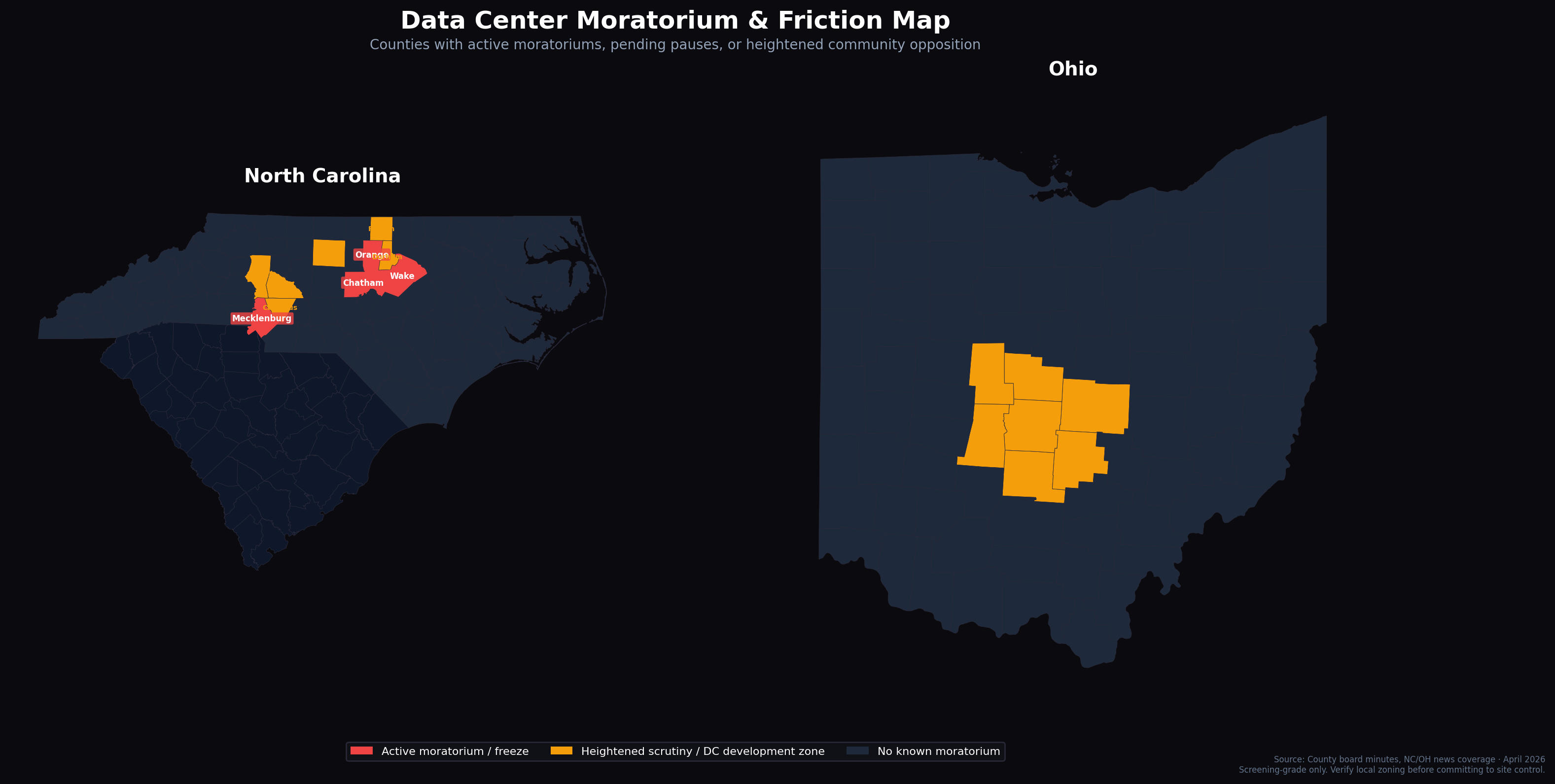
- Moratoriums: Orange County, Chatham County, Wendell, and Apex have active pauses
- NC Tax Exemption: Sales & use tax exempt at $75M+ investment within 5 years
- Water Risk: Statewide moderate-to-extreme drought since August 2025
- SC Land Advantage: $18K-22K/acre rural vs $50K-70K+/acre NC metro
- Active Hyperscalers: Apple, Google, Meta, Microsoft, Amazon with $38B+ committed
Why Duke Energy Controls the Carolinas Timeline
6 GW Queue Pipeline
Duke Energy projects 6 GW of data center demand in its Carolinas pipeline, up from 3.9 GW in early 2024. Data centers currently represent less than 1% of peak demand but are projected to reach 10% of total electricity sales by 2030.
Source: Duke Energy IRP filings & earnings calls · as of 2025 Q4
Moratorium Wave Spreading
Roughly a dozen NC local governments have passed moratoriums pausing data center development. Orange County, Chatham County, Wendell, and Apex have active freezes. Charlotte is considering its own pause. Each moratorium adds 12+ months of site risk.
Source: County board minutes & NC news coverage · as of 2026-04
Statewide Drought Risk
North Carolina has been in moderate-to-extreme drought since August 2025. A proposed 300 MW facility in Apex would consume 1M gallons/day. Water is now a permitting gatekeeper, especially near Raleigh where restrictions are in effect.
Source: US Drought Monitor & NC DEQ · as of 2026-04
$450M/yr Tax Break at Risk
Governor Stein is pushing to repeal or overhaul NC's data center sales tax exemption, currently worth an estimated $450M annually if all planned facilities are built. The Energy Policy Task Force may tie exemptions to carbon-free energy or water reporting.
Source: NC General Assembly fiscal note & governor press office · as of 2026-03
The 5-Filter Carolinas Screening Framework
Screen in this order. Each filter is eliminatory. The Carolinas present a unique dual-state, single-utility dynamic that requires checking Duke Energy capacity before anything else.
- 1
Duke Energy Service Territory & Transmission Capacity
Duke Energy Carolinas (DEC) and Duke Energy Progress (DEP) serve different geographies with different capacity profiles. Charlotte metro is DEC; Raleigh/RTP is DEP. Duke requires a Letter Agreement and transmission study before an Energy Supply Agreement. Urban and high-growth areas face constrained transmission and longer timelines. Engage Duke early to identify available capacity.
- 2
County Moratorium & Zoning Status
At least 12 NC counties and municipalities have active or pending data center moratoriums as of April 2026. Check county-level zoning before committing to a site. Moratoriums in Orange County, Chatham County, Wendell, and Apex each impose 12-month freezes. Charlotte is actively debating a pause. Rowan County recently approved rezoning, making it an exception worth watching.
- 3
Water Availability & Drought Exposure
North Carolina is in its worst drought since 2007. Data centers using evaporative cooling can consume 500K-1M+ gallons/day. NC has no statewide rules requiring data centers to disclose water use or limiting consumption during drought. Sites with access to reclaimed water or air-cooled designs have a material permitting advantage.
- 4
NC vs SC State Incentive Comparison
North Carolina offers sales and use tax exemption on equipment and electricity for data centers investing $75M+ within 5 years, but this incentive is under political threat. South Carolina offers lower land costs and competitive utility rates but Dominion Energy SC's CEO has signaled reluctance to pursue DC load. Weigh the incentive risk against SC's cost advantages.
Compare Carolinas vs ERCOT Economics - 5
Interconnection Cost Allocation & Timeline
Duke Energy requires large load customers to pay the full cost of grid connection, including transmission lines, substations, and local distribution upgrades. Contracts include minimum bills, termination penalties, and letters of credit. Duke aggregates customers into tranches similar to generator interconnection clusters. Expect 24-36+ month timelines for new connections at scale.
View Duke Energy Time-to-Power Scores
Carolinas Markets Compared: Where the Power and Risk Sit
The Carolinas market splits across two states, two Duke Energy subsidiaries, and wildly different local politics. Charlotte leads in existing capacity but faces the most political headwinds.
| Market | Capacity | Queue Depth | Time-to-Power | Notes |
|---|---|---|---|---|
| Charlotte Metro (NC) | 400+ MW operating (Digital Realty expanding to 400 MW campus) | Deep - DEC transmission constrained | 24-36 months | Moratorium debate active. Drought + heat island concerns. Premium land pricing. |
| Raleigh / Durham / RTP (NC) | 150+ MW operating (TierPoint 8 MW, multiple colo) | Moderate - DEP territory, Orange/Chatham moratoriums | 24-36 months | Microsoft 1,385-acre Person County site. Moratoriums in adjacent counties. |
| Rowan County / Rural NC Piedmont | Greenfield - rezoning approved | Lower - less competition for capacity | 18-30 months | Pro-development zoning. WhiteFiber NC-1: 24-200 MW. Near Duke baseload generation. |
| Greenville / Upstate SC | Emerging - limited existing colo | Early stage - Duke Energy Carolinas territory | 24-36 months | Lower land costs ($18-22K/acre). Less fiber than NC. Growing interest. |
| Berkeley County / Lowcountry SC | Google campus under construction | Moderate - Dominion Energy SC territory | 30-48 months | Google $9B+ investment. Dominion SC CEO signaled reluctance on new DC load. |
The Numbers That Matter
Land
- NC metro (Charlotte, RTP): $50K-70K+/acre
- NC rural (Rowan, Richmond, Person): $15K-30K/acre
- SC rural (Berkeley, Colleton): $18K-22K/acre
- Hyperscale campuses: 200-1,385 acres (Microsoft Person County)
Power
- Duke Energy pipeline: 6 GW data center demand in Carolinas
- Current DC load: <1% of peak, projected 10% of sales by 2030
- Industrial rate: ~$0.065-0.075/kWh (DEC/DEP, rising 5-13%)
- Full interconnection cost borne by customer (lines, substations, LCs)
Water
- Large DC: up to 1M gallons/day (300 MW Apex proposal)
- Meta Forest City (30 MW): 4.2M gallons/year total
- Statewide drought: moderate-to-extreme since August 2025
- No statewide disclosure or drought-limit rules for DCs
Incentives
- NC: Sales & use tax exemption at $75M+ investment / 5 years
- NC exemption value: est. $45-57M/year currently, $450M/yr at full buildout
- Amazon Richmond County: 50% property tax + 65% personal property relief / 20yr
- Incentive sunset risk: Gov. Stein actively pushing repeal or overhaul
From Screening to Shortlist: The Carolinas Time-to-Power Pack
This guide gives you the framework. The pack gives you the data. Move from broad Carolinas screening to a ranked shortlist that accounts for Duke Energy queue position, moratorium risk, and county-level readiness.
Carolinas Time-to-Power Pack
NC vs SC shortlist comparison pack for faster Carolinas siting and underwriting alignment.
What you get
- Ranked Carolinas site dataset
- Readiness, grid, and permitting context fields by state
- Export-ready diligence package structure
Also included with your purchase
- Readiness Explorer
- Watchlists Workspace
- Standard Exports
Decision support only. Not a utility commitment, parcel-level MW guarantee, interconnection guarantee, or permitting guarantee.
One-time purchase. Self-serve checkout. No calls or demos required. Pack outputs generate immediately after unlock in GLRI.
The pack gives the current view. The Watchlist tracks what changes after.
Queue positions shift. Moratoriums expand. Capacity auctions reprice. Use the Speed-to-Power Watchlist ($99/mo) to monitor your shortlist with live readiness signals, threshold alerts, and recurring exports.
Frequently Asked Questions
How long does Duke Energy data center interconnection take in the Carolinas?
Duke Energy large-load interconnection currently takes 24-36+ months depending on transmission availability, service territory (DEC vs DEP), and tranche scheduling. Duke aggregates customers into study clusters similar to generator interconnection queues. Urban areas like Charlotte face longer timelines due to transmission constraints. Early engagement with Duke is critical to identify available capacity.
Which North Carolina counties have data center moratoriums?
As of April 2026, at least a dozen NC local governments have active or pending moratoriums. Confirmed active moratoriums include Orange County (one-year, April 2026), Chatham County (one-year, February 2026), Wendell (through December 2026), and Apex (one-year suspension). Charlotte is actively debating a moratorium. Rowan County is a notable exception, having recently approved data center rezoning.
What are the tax incentives for data centers in North Carolina?
Under the NC Competes Act, data centers investing at least $75 million within 5 years qualify for sales and use tax exemptions on construction materials, servers, and electricity. Existing DCs save an estimated $45-57 million annually in sales taxes. However, Governor Stein is actively pushing to repeal or overhaul these exemptions, potentially tying them to carbon-free energy use or mandatory water/energy reporting.
Is South Carolina cheaper than North Carolina for data centers?
South Carolina offers lower rural land costs ($18-22K/acre vs $50-70K+ in NC metro areas) and competitive utility rates. However, SC has thinner fiber infrastructure than NC, fewer established colocation providers, and Dominion Energy South Carolina's CEO has signaled reluctance to pursue data center load. Duke Energy Carolinas serves the Upstate SC region (Greenville), providing a more favorable utility dynamic than Dominion-served Lowcountry.
How much water do data centers use in North Carolina?
Water consumption varies widely by cooling technology and facility size. A proposed 300 MW facility in Apex would consume up to 1 million gallons per day, with one-third lost to evaporation. Meta's 30 MW Forest City facility used 4.2 million gallons total in 2024. North Carolina has been in moderate-to-extreme drought since August 2025 and has no statewide rules requiring DCs to disclose water use or limit consumption during drought.
Who are the major data center operators in the Carolinas?
Apple (Maiden, 500K+ sf), Google (Lenoir $1.2B+, Berkeley County SC $9B+), Meta (Forest City), Microsoft (Person County 1,385 acres), Amazon (Richmond County $10B, 20 buildings), Digital Realty (Charlotte 400 MW campus), WhiteFiber (Madison NC, 24-200 MW), and TierPoint (Raleigh RTP, 8 MW). Combined announced investment exceeds $38 billion.
What is the difference between Duke Energy Carolinas and Duke Energy Progress?
Duke Energy Carolinas (DEC) and Duke Energy Progress (DEP) are separate regulated subsidiaries serving different geographies. DEC covers Charlotte metro and western NC plus Upstate SC. DEP covers eastern NC including Raleigh/RTP. Each has different rate structures, transmission capacity, and interconnection timelines. Both require large-load customers to pay full interconnection costs including transmission upgrades, substations, and security deposits.
Known limitations
- —Duke Energy pipeline (6 GW) is a utility projection, not confirmed load — actual buildout will be lower.
- —Moratorium list is based on public reporting; some municipalities may have enacted pauses without coverage.
- —Drought conditions are seasonal — current status may differ from publication date.
- —$450M/yr incentive value assumes full buildout of all planned facilities, which is unlikely.
- —This page is decision-support research. It is not a utility commitment, engineering study, or legal opinion.
Related Guides
Texas Site Selection Playbook
Compare ERCOT queue dynamics and the power-first screening framework.
PJM vs ERCOT for Datacenters
Queue timelines, capacity costs, and grid reliability compared.
PJM Queue Deep Dive
Interconnection queue analysis for the mid-Atlantic and Ohio markets.
Behind-the-Meter Guide
Skip the interconnection queue with on-site generation strategies.