Data Center Site Selection in Texas: The Power-First Playbook
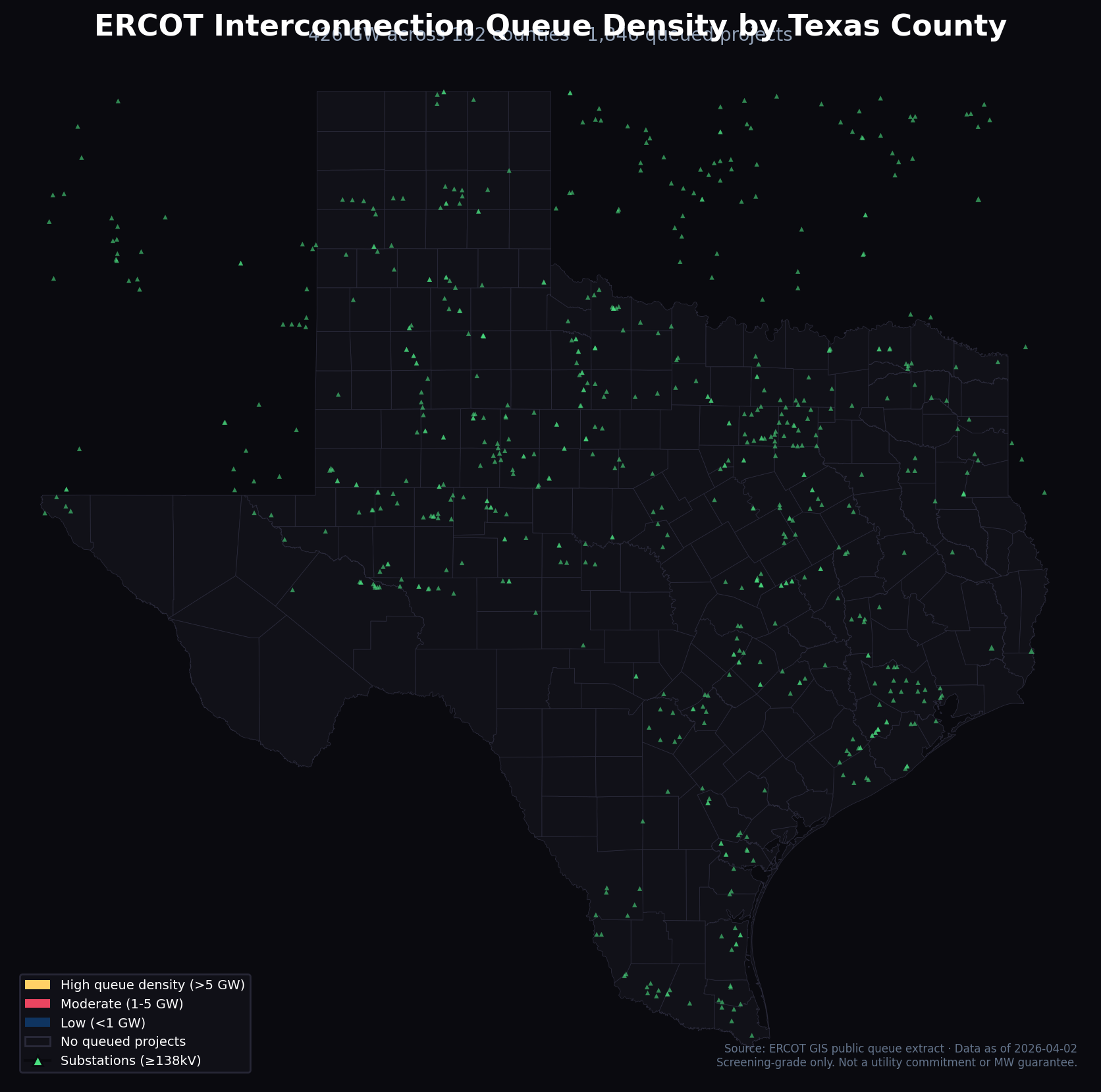
410 GW in the ERCOT queue. 87% from data centers. Only 1.8% operational. The site that wins is the site with power. Here is how to screen for it.
How do you select a data center site in Texas?
Start with power, not location. Screen for substation headroom and ERCOT queue position first, then layer curtailment risk, land and water clearance, and the Texas incentive stack. Projects that qualified for ERCOT's Batch Zero in March 2026 demonstrated site control, executed TSAs, and 18-24 month load readiness.
Key Data Points
- ERCOT Queue: 410 GW total, 87% data centers, 1.8% operational
- Batch Zero: Priority processing launched March 2026
- SB6: Interconnection costs shifted to large-load customers
- Land: 40-500+ acres, DFW campuses span 200-400 acres
- Tax Incentive: $200M investment / 100K sf / 20 employees
- 84 operating DCs, 140 planned, 75 GW planned capacity
Why Power Kills More Texas Deals Than Location
410 GW Queue Backlog
ERCOT's interconnection queue surged to 410 GW — up 6.5x from 63 GW just 18 months ago. 87% of requests are from data centers. Only 1.8% is operational. The system received 225+ applications in 2025 alone.
Source: ERCOT GIS public queue extract · as of 2026-04-02
17% Substation Headroom
Only 17% of DC-eligible land in Texas shows positive withdrawal headroom at nearby substations. The rest is effectively stranded by existing grid constraints.
Source: GLRI substation-headroom model (ERCOT OASIS inputs) · as of 2026-03
Batch Zero (March 2026)
ERCOT's priority interconnection lane requires demonstrated site control, executed transmission service agreements, and 18-24 month load readiness. Projects outside Batch Zero face years-long waits.
Source: ERCOT NPRR/PGRR filings · as of 2026-03-04
SB6 Cost Shift
Senate Bill 6 (June 2025) shifted interconnection costs and reliability obligations onto large-load customers. This changes the economics of every Texas site evaluation.
Source: Texas Legislature SB6 enrolled text · as of 2025-06
The 5-Filter Site Screening Framework
Screen in this order. Each filter is eliminatory — if a site fails at any stage, don't spend resources on the next one.
- 1
Substation Headroom & Withdrawal Capacity
Identify substations within 5 miles rated 138kV+ with positive withdrawal headroom. Sites near tapped-out substations require transmission upgrades costing tens of millions and adding years. This single filter eliminates ~83% of Texas DC-eligible land.
- 2
Interconnection Timeline
The 18-24 month window is the competitive sweet spot. Sites that can demonstrate load readiness in this range qualify for Batch Zero priority. Beyond 36 months, capital cost of delay erodes project economics. Check ERCOT queue position and transmission study status.
- 3
Curtailment Risk & Grid Reliability
Texas's renewable-heavy grid means curtailment risk varies significantly by zone. West Texas faces higher curtailment from wind oversupply. Coastal zones have different risk profiles from natural gas dependency. Use curtailment stress scores to quantify zone-level risk before committing.
View ERCOT Curtailment Stress Scores - 4
Land, Water & Environmental Clearance
Minimum 40 acres for single-building; 200-400+ acres for hyperscale campuses. Confirm FEMA 500-year floodplain clearance, geotechnical suitability, and water access. Texas DC water usage projections range from 29B to 161B gallons/year by 2030 — water is becoming a permitting gatekeeper in water-stressed regions.
- 5
Permitting & Tax Incentive Stack
Texas sales tax exemption requires 100K+ sf, $200M+ capital investment, and 20+ employees at above-average wages. Streamlined permitting in rural communities (Abilene, Lockhart, Red Oak) can cut 6-12 months from urban permitting timelines. Check local zoning — many Texas municipalities don't have data center-specific zoning categories.
Behind-the-Meter as Queue Bypass
Texas Markets Compared: Where the Power Actually Is
Not all Texas markets are created equal. DFW dominates in existing capacity but faces the tightest constraints. The real opportunity may be in the next tier.
| Market | Capacity | Queue Depth | Time-to-Power | Notes |
|---|---|---|---|---|
| Dallas-Fort Worth | 1,200+ MW operating | Deep — transmission constrained | 24-36 months | Doubling by end of 2026. Premium land pricing. |
| Austin / Central TX | 460+ MW under construction | Moderate — greenfield available | 18-30 months | Construction 4x year-over-year. Temple emerging. |
| San Antonio | Growing | Lower — CPS Energy advantage | 18-24 months | Municipal utility with available capacity. |
| Emerging (Abilene, Laredo, Amarillo) | Planned only | Early stage | 24-48 months | Cheap land, power buildout required. Stargate-class campuses. |
The Numbers That Matter
Land
- Minimum: 40 acres (single facility)
- Hyperscale DFW: 200-400+ acres
- Mega-campus (Amarillo, Laredo): 1,000-5,800 acres
- Rural TX: significantly cheaper than DFW metro pricing
Power
- ERCOT energy: ~$35-45/MWh (renewable-heavy)
- 84 operating DCs, 3,789 MW operating capacity
- 140 planned DCs, 75,089 MW planned capacity
- SB6 shifts interconnection costs to load customers
Water
- Projected: 29-161B gallons/year by 2030
- Reclaimed water saves millions vs potable
- Air-cooled designs reduce dependency
- Increasingly a permitting gatekeeper
Incentives
- Sales tax exemption on equipment + electricity
- Threshold: 100K sf / $200M invest / 20 employees
- No state income tax
- Deregulated energy market enables PPA flexibility
From Screening to Shortlist: The Texas Time-to-Power Pack
This guide gives you the framework. The pack gives you the data. Move from broad Texas screening to a ranked shortlist with export-ready diligence fields.
Texas Time-to-Power Pack
Ranked Texas shortlist for ERCOT-first screening, delivered as a decision artifact you can use immediately.
What you get
- Ranked Texas site dataset
- Readiness scoring context and risk flags
- Report + raw export format for internal review
Also included with your purchase
- Readiness Explorer
- Watchlists Workspace
- Standard Exports
Decision support only. Not a utility commitment, parcel-level MW guarantee, interconnection guarantee, or permitting guarantee.
One-time purchase. Self-serve checkout. No calls or demos required. Pack outputs generate immediately after unlock in GLRI.
The pack gives the current view. The Watchlist tracks what changes after.
Queue positions shift. Moratoriums expand. Capacity auctions reprice. Use the Speed-to-Power Watchlist ($99/mo) to monitor your shortlist with live readiness signals, threshold alerts, and recurring exports.
Frequently Asked Questions
How long does ERCOT interconnection take for data centers?
ERCOT large-load interconnection currently takes 18-48 months depending on queue position, transmission availability, and whether the project qualifies for Batch Zero priority processing. Projects outside Batch Zero face multi-year waits in a 410 GW queue where 87% of requests are from data centers.
What is ERCOT Batch Zero?
Batch Zero is ERCOT's priority interconnection process launched in March 2026 for projects that can demonstrate site control, executed transmission service agreements, and load readiness within 18-24 months. It represents the first wave of large-load projects to receive accelerated grid connection review.
How much land do you need for a data center in Texas?
A minimum of 40 acres for a single-building facility. Hyperscale campuses in DFW typically span 200-400+ acres. Emerging corridors like Amarillo and Laredo are seeing 1,000+ acre campus plans for multi-GW deployments.
What are the tax incentives for data centers in Texas?
Texas offers a sales tax exemption on equipment and electricity for data centers that meet three thresholds: at least 100,000 square feet of floor space, minimum $200 million capital investment, and at least 20 full-time employees at above-average wages. Chapter 313 successor programs may offer additional property tax abatements.
How close to a substation does a data center need to be in Texas?
Sites within 2-5 miles of a high-voltage substation (138kV+) with available withdrawal headroom can connect faster and at lower cost. Sites beyond 10 miles typically require costly transmission line extensions that add 12-24 months to project timelines. Only about 17% of Texas DC-eligible land has positive substation headroom.
What is the interconnection queue backlog in Texas?
As of April 2026, ERCOT is tracking 410 GW of interconnection requests — up 6.5x from 63 GW in late 2024. 87% of these requests are from data centers. Only 1.8% of queued capacity is operational. Over 50% of submissions lack complete documentation.
How much water does a Texas data center use?
Water consumption varies by cooling technology. Estimates project Texas data centers could use 29-161 billion gallons annually by 2030. Air-cooled and hybrid designs reduce water dependency. Reclaimed water can save millions compared to potable supply. Water access is increasingly a gating factor in permitting.
Known limitations
- —Queue depth (410 GW) is a snapshot; ERCOT updates weekly and speculative entries inflate totals.
- —Substation headroom estimates use public OASIS data — actual availability requires ERCOT engineering study.
- —Batch Zero criteria are based on filed NPRR/PGRR text; ERCOT Board approval is pending.
- —Land pricing and incentive thresholds are approximations — verify with county appraisal districts and counsel.
- —This page is decision-support research. It is not a utility commitment, engineering study, or legal opinion.
Related Guides
PJM vs ERCOT for Datacenters
Compare queue timelines, capacity costs, and grid reliability.
Behind-the-Meter Guide
Skip the interconnection queue with on-site generation.
Data Center PPA Guide
Structure a power purchase agreement for Texas facilities.
Mining-to-AI Conversion
Convert existing Bitcoin mining sites to AI infrastructure.