North Carolina Data Center Moratorium Map: Every County, Every Freeze, Updated April 2026
At least 20 North Carolina jurisdictions have enacted data center moratoriums or outright bans since late 2025. Charlotte is deadlocked. A state bill would kill tax exemptions entirely. This is the definitive tracker for site developers navigating the regulatory freeze.
Which North Carolina counties have data center moratoriums in 2026?
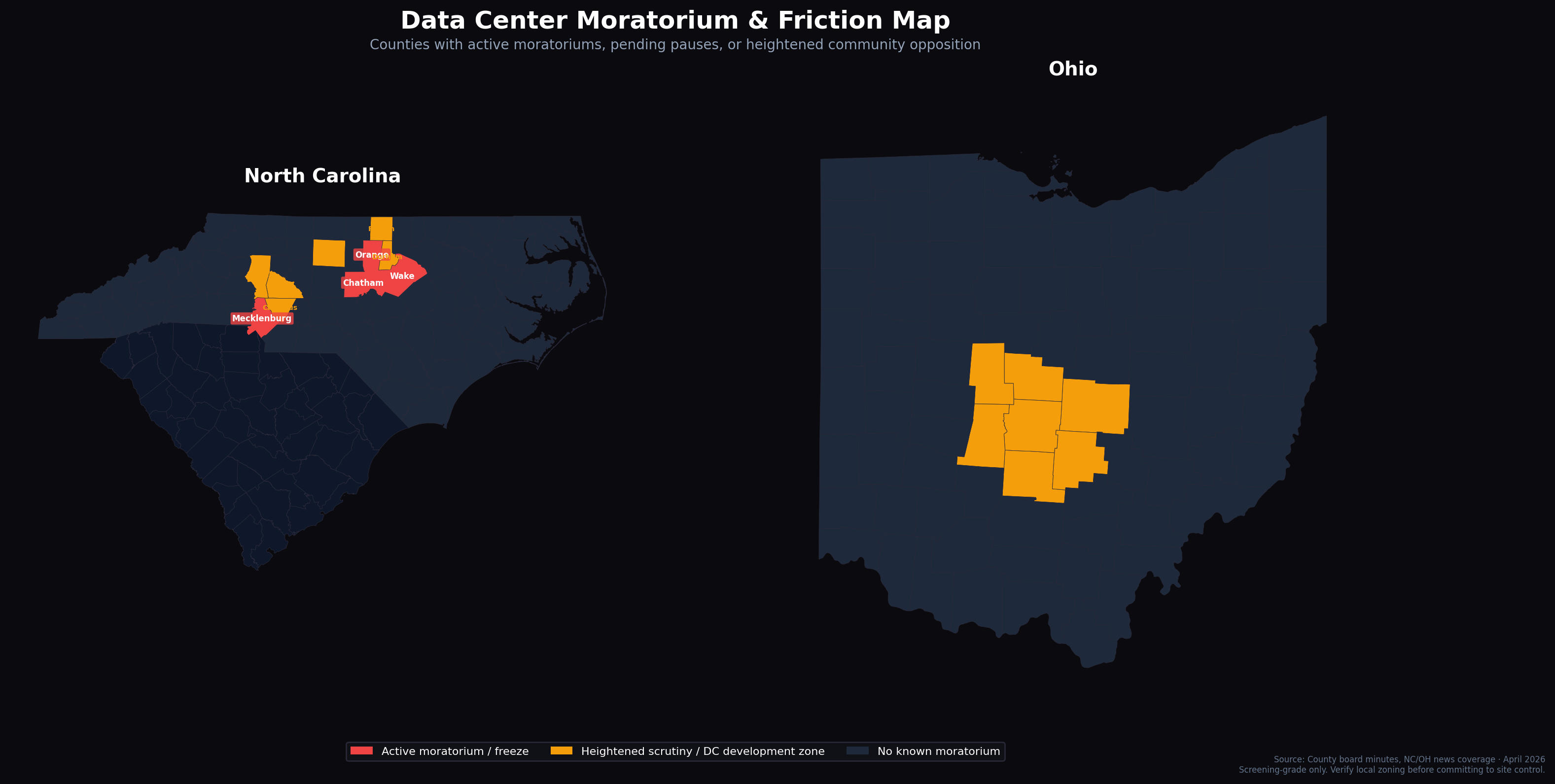
As of April 2026, over 20 NC counties, cities, and towns have active moratoriums or permanent bans on data center construction. The wave started with Gates County in December 2025, spread through western NC mountain communities (Watauga, Swain, Madison, Clay, Brevard, Canton, Boone, Clyde), then hit the Triangle corridor (Chatham County, Orange County, Apex, Wendell) and the Charlotte region (Rowan County, Kings Mountain). Charlotte City Council is deadlocked 5-5 after the mayor cast a tie-breaking vote against even holding a public hearing. Chatham County faces a lawsuit from Eco TIP West LLC over its 750 MW project freeze.
Key Data Points
- 20+ jurisdictions with active moratoriums or bans as of April 2026
- Gates County was first (December 2025); Apex, Orange, Rowan, Swain newest (April 2026)
- Chatham County sued by Eco TIP West LLC over frozen 750 MW / 400-acre project
- Charlotte deadlocked 5-5; Mayor Lyles cast tie-breaker against public hearing
- HB 1063 would repeal all NC data center tax exemptions ($450M/yr at full buildout)
- Duke Energy: data centers = 80% of projected new load growth despite <1% current share
- Western NC: 8+ mountain communities passed bans, driven by noise and water concerns
Why the Moratorium Wave Is Reshaping NC Site Selection
20+ Active Moratoriums
Over 20 NC jurisdictions have enacted moratoriums or permanent bans since December 2025. The wave spans from Gates County in the northeast to Swain County in the far west, with the densest cluster in the Triangle corridor (Chatham, Orange, Apex, Wendell). Each moratorium typically runs 12 months and freezes all new data center permitting.
Source: County board minutes & NC news coverage · as of 2026-04
Chatham Lawsuit Sets Precedent
Eco TIP West LLC sued Chatham County after its 12-month moratorium froze a planned 750 MW data center on a 400-acre site at Triangle Innovation Point. The developer claims $11M+ already invested and argues data centers were a permitted use in Heavy Industrial zoning. The outcome will define moratorium legality statewide.
Source: Chatham County Superior Court filings · as of 2026-03
HB 1063: Tax Exemption Kill Bill
House Bill 1063 would repeal all NC data center sales tax exemptions, currently worth $45-57M/year and projected at $450M/year at full buildout. It would also ban evaporative cooling, mandate public reporting of water and power use, and require 25% carbon-free generation for facilities over 40 MW. Democrats are minority, but pressure is building.
Source: NC General Assembly bill tracker · as of 2026-03
80% of New Load Growth
Duke Energy reports that data centers account for 80% of projected new electricity demand growth in North Carolina, despite representing less than 1% of current peak load. Duke is seeking an 18% residential rate increase over two years partly to fund grid expansion for these facilities. Rate anger fuels moratorium politics.
Source: Duke Energy IRP filings & rate case testimony · as of 2025 Q4
The 5-Step Moratorium Navigation Framework
Moratoriums are not uniform. Some have carve-outs for projects with existing permits. Some exclude specific parcels under state law. The framework below separates navigable freezes from hard blocks.
- 1
Map Active vs Pending Moratoriums
Distinguish between enacted moratoriums (legally binding, typically 12-month duration) and moratoriums under discussion (public hearing scheduled but no vote yet). Charlotte, Durham, Harnett County, Cumberland County, and Fayetteville are in the pending category as of late April 2026. Pending jurisdictions may still accept applications filed before the effective date.
- 2
Check for Vesting Rights and Grandfathering
North Carolina state law limits moratorium scope for projects with existing permits or vested rights. Rowan County's moratorium explicitly cannot include the Long Ferry Road project because site preparation was already underway. Chatham County's lawsuit hinges on whether Eco TIP West had a vested right under its Heavy Industrial zoning. File early in pending jurisdictions to establish grandfathering claims.
- 3
Assess Duration and Expiration Windows
Most NC moratoriums are 12 months, but durations vary. Brevard passed a 90-day moratorium (September 2025), Kings Mountain passed 6 months (February 2026), and Wendell's expires December 31, 2026. Track expiration dates to identify when jurisdictions will reopen and whether new permanent zoning regulations will replace the temporary freeze.
View Full Carolinas Site Selection Guide - 4
Identify Moratorium-Free Corridors
Not every NC county is hostile. Person County approved Microsoft's 1,385-acre campus. Vance County rezoned for a potential data center in April 2026. Richmond County hosts Amazon's $10B complex. Rowan County approved rezoning before passing its moratorium. Focus on counties with pro-development leadership, existing hyperscaler presence, and available Duke Energy transmission capacity.
- 5
Model the Post-Moratorium Regulatory Landscape
Moratoriums buy time for counties to draft permanent zoning ordinances. Swain County created two citizen advisory committees. Orange County staff is studying land use policy revisions. The post-moratorium regulations will likely include noise limits, setback requirements, water use caps, and heat island mitigation. Model these future requirements into site selection now to avoid a second round of delays.
View Duke Energy Time-to-Power Scores
NC Moratorium Map: Region-by-Region Status
The moratorium wave clusters in three zones: Western NC mountains (environmental/noise driven), Triangle corridor (water/growth driven), and Charlotte metro (political/rate-driven). Each has different dynamics and workaround potential.
| Market | Capacity | Queue Depth | Time-to-Power | Notes |
|---|---|---|---|---|
| Triangle Corridor (Chatham, Orange, Apex, Wendell, Durham pending) | 750+ MW frozen (Chatham alone) | Deep -- Duke Energy Progress territory, multiple moratoriums overlap | 36-48+ months (moratorium + post-moratorium zoning) | Chatham lawsuit is the bellwether. Orange has no existing DCs and limited water. Apex withdrew Natalli $4M+ project. Durham considering moratorium. |
| Charlotte Metro (Charlotte, Rowan, Kings Mountain) | 400+ MW operating (Digital Realty campus) | Deep -- DEC transmission constrained, political headwinds | 24-36 months (if moratorium avoided) | Council deadlocked 5-5. Mayor blocked public hearing. Rowan moratorium excludes Long Ferry Road. American Tower 40K sf east Charlotte project vote May 18. |
| Western NC Mountains (Watauga, Swain, Madison, Clay, Brevard, Canton, Boone, Clyde) | Minimal existing -- greenfield proposals blocked | N/A -- rural transmission, limited capacity | Indefinite (multiple permanent bans likely) | 8+ jurisdictions with bans. Driven by noise, water, farmland loss. Swain drew 140 residents to hearing. Likely permanent zoning restrictions. |
| Northeastern NC (Gates County) | Greenfield -- no operating DCs | Early stage -- limited infrastructure | 24-36 months (moratorium expires ~Dec 2026) | First NC moratorium (December 2025). Covers data centers and crypto mining. Rural area, was among earliest to act. |
| Moratorium-Free Corridors (Person, Vance, Richmond, Mecklenburg unincorporated) | 1,000+ MW planned (Microsoft Person County, Amazon Richmond) | Moderate -- hyperscaler demand absorbing capacity | 24-36 months | Person County: Microsoft 1,385 acres. Richmond: Amazon $10B / 20 buildings. Vance rezoned April 2026. Best remaining corridors for new entrants. |
The Moratorium Numbers
Moratorium Scope
- 20+ NC jurisdictions with active moratoriums or bans
- 12 months: most common moratorium duration
- 90 days (Brevard) to indefinite (WNC mountain bans)
- Gates County first (Dec 2025); Apex/Orange/Rowan/Swain newest (April 2026)
Power & Rate Impact
- Duke Energy: 6 GW DC demand in Carolinas pipeline
- DCs = 80% of projected new load growth
- 18% residential rate hike proposed over 2 years
- HB 1063: 25% carbon-free mandate for 40+ MW facilities
Water & Environment
- 300 MW facility: up to 1M gallons/day water use
- NC drought: moderate-to-extreme since August 2025
- HB 1063 would ban evaporative cooling statewide
- Heat island research shows multi-degree temperature spikes near DCs
Legal & Financial
- Eco TIP West: $11M+ invested before Chatham freeze
- Current tax exemption: $45-57M/year to DC operators
- Projected exemption cost: $450M/year at full buildout
- Stokes County: community lawsuit to block DC on environmental grounds
From Moratorium Risk to Actionable Shortlist: The Carolinas Pack
This tracker gives you the regulatory picture. The pack gives you the site-level data. Identify which corridors remain open, which moratoriums expire soonest, and where Duke Energy capacity aligns with permitting reality.
Carolinas Time-to-Power Pack
NC vs SC shortlist comparison pack for faster Carolinas siting and underwriting alignment.
What you get
- Ranked Carolinas site dataset
- Readiness, grid, and permitting context fields by state
- Export-ready diligence package structure
Also included with your purchase
- Readiness Explorer
- Watchlists Workspace
- Standard Exports
Decision support only. Not a utility commitment, parcel-level MW guarantee, interconnection guarantee, or permitting guarantee.
One-time purchase. Self-serve checkout. No calls or demos required. Pack outputs generate immediately after unlock in GLRI.
The pack gives the current view. The Watchlist tracks what changes after.
Queue positions shift. Moratoriums expand. Capacity auctions reprice. Use the Speed-to-Power Watchlist ($99/mo) to monitor your shortlist with live readiness signals, threshold alerts, and recurring exports.
Frequently Asked Questions
Which North Carolina counties have active data center moratoriums in 2026?
As of April 2026, confirmed active moratoriums exist in: Gates County (December 2025), Brevard (September 2025), Clay County (September 2025), Canton (February 2026), Chatham County (February 2026), Kings Mountain (February 2026), Boone (March 2026), Apex (April 2026), Orange County (April 2026), Rowan County (April 2026), Swain County (April 2026), plus Watauga County, Madison County, and Clyde. Additional jurisdictions including Charlotte, Durham, Harnett County, Cumberland County, and Fayetteville are actively considering moratoriums.
What triggered the North Carolina data center moratorium wave?
Multiple converging factors drove the moratorium wave: Duke Energy projecting 6 GW of data center demand (80% of new load growth) while seeking 18% residential rate increases; North Carolina's worst drought since 2007 coinciding with proposed facilities consuming up to 1 million gallons of water per day; noise and heat island complaints from existing facilities; loss of farmland to industrial-scale campuses; and a perception that $450M in annual tax exemptions benefit corporations while residents bear infrastructure costs.
Can data centers still be built in North Carolina despite the moratoriums?
Yes. Moratoriums are geographically limited to specific jurisdictions. Person County permitted Microsoft's 1,385-acre campus, Vance County approved rezoning in April 2026, and Richmond County hosts Amazon's $10B complex. Projects with vested rights or existing permits may also be exempt from moratoriums, as demonstrated by the Long Ferry Road exclusion in Rowan County. The key is identifying moratorium-free corridors with available Duke Energy transmission capacity.
What is the Chatham County data center lawsuit about?
Eco TIP West LLC, associated with Kirk Bradley of Lee-Moore Capital, sued Chatham County after its 12-month moratorium (effective February 11, 2026) froze a planned 750 MW data center on a 400+ acre site at Triangle Innovation Point near Moncure. The developer claims over $11 million in pre-moratorium investment and argues data centers were a permitted use in the Heavy Industrial zoning district. The developer seeks a court declaration that the moratorium is unlawful and the project should be exempt. The outcome will set statewide precedent for moratorium legality.
What would House Bill 1063 do to NC data center development?
HB 1063, the Ratepayer and Resource Protection Act, would: (1) repeal all data center sales and use tax exemptions currently worth $45-57M/year; (2) prohibit state and local governments from offering infrastructure grants or property tax abatements; (3) ban evaporative cooling methods; (4) mandate public reporting of electricity, water, and emissions data; (5) require facilities over 40 MW or using 1B+ liters of water annually to generate 25% of power from carbon-free sources. The bill faces long odds as Democrats hold minority status in the NC House.
Why did Charlotte's mayor block the data center moratorium?
On April 28, 2026, Charlotte City Council voted 5-5 on a motion to hold a public hearing on data centers. Mayor Vi Lyles cast the tie-breaking vote against, stating she did not feel comfortable discussing the topic without research and information, and that city staff would not have recommendations for another three to six months. She did add a data center discussion to the May 11 council agenda, but council cannot vote on the issue at that meeting. The American Tower east Charlotte project vote is scheduled for May 18.
How do North Carolina data center moratoriums affect Duke Energy interconnection timelines?
Moratoriums add 12+ months of delay on top of Duke Energy's already 24-36 month interconnection timeline. A project in a moratorium jurisdiction faces a minimum 36-48+ month total time-to-power when accounting for the moratorium period, post-moratorium zoning review, and then the Duke Energy interconnection process. Projects in moratorium-free corridors (Person, Vance, Richmond counties) maintain the standard 24-36 month Duke Energy timeline.
Are Western North Carolina data center bans permanent?
Most Western NC moratoriums are technically temporary (12 months), but the political dynamics suggest permanent or near-permanent restrictions are likely. Swain County created two citizen advisory committees to draft stricter long-term ordinances. The WNC mountain communities (Watauga, Boone, Canton, Madison, Brevard, Clay, Clyde, Swain) are driven by strong environmental constituencies concerned about noise, water, farmland preservation, and the character of mountain communities. Site developers should treat WNC as effectively unavailable for large-scale data center development.
What are the moratorium-free corridors still open in North Carolina?
The strongest remaining corridors for NC data center development are: Person County (Microsoft 1,385-acre campus permitted), Richmond County (Amazon $10B / 20-building complex), Vance County (rezoned April 2026), and portions of the Charlotte metro outside the city limits. These jurisdictions have demonstrated pro-development leadership, existing hyperscaler investment, and available Duke Energy transmission capacity. However, adjacency to moratorium counties creates political contagion risk.
Known limitations
- —Moratorium count (20+) is based on public reporting; some jurisdictions may have enacted pauses without coverage.
- —Chatham lawsuit is pending — outcome will set precedent but is not yet decided.
- —HB 1063 is filed legislation, not enacted law; passage probability is uncertain.
- —Load growth projections (80%) are Duke Energy estimates subject to revision.
- —This page is decision-support research. It is not a utility commitment, engineering study, or legal opinion.
Related Guides
Carolinas Site Selection Playbook
Full 5-filter screening framework covering Duke Energy queue, incentives, and SC comparison.
Texas Site Selection Playbook
ERCOT-first screening with no moratorium risk. Compare the regulatory climate.
Georgia Site Selection Playbook
Atlanta-priority screening as an alternative Southeast corridor.
PJM vs ERCOT for Datacenters
Queue timelines, capacity costs, and grid reliability compared across ISOs.